Home renovation can improve comfort, appearance, and property value — but it can also temporarily introduce dust, chemical vapors, odors, moisture, and other airborne contaminants. For a Bethesda-area household that includes someone with asthma, renovation planning should address more than the finished look of the project. It should also address what enters the air, how contaminants will be contained, where fumes will be exhausted, and when sensitive occupants can safely return.
This is especially important during hardwood-floor installation or refinishing. Floor sanding produces fine wood dust, while stains, adhesives, sealers, and finishes may release chemical emissions as they dry and cure. If you are hiring a licensed Maryland flooring contractor or any other tradesperson for interior work, ask — before you sign — for a written indoor-air-quality plan covering product selection, dust containment, ventilation, cleaning, curing, and re-entry.
Why renovation planning matters for people with asthma
Asthma symptoms can be triggered or aggravated by airborne dust, mold, fragrances, smoke, and certain chemical vapors, producing coughing, wheezing, chest tightness, and difficulty breathing. The Centers for Disease Control and Prevention advises people with asthma to identify and reduce exposure to their individual triggers while continuing the treatment plan prescribed by their healthcare provider.
Renovation may temporarily increase exposure to:
- Construction and drywall dust
- Airborne wood dust
- Paint and coating vapors
- Flooring adhesives
- Fragranced products
- Mold disturbed inside walls or beneath flooring
- Dust circulated through the HVAC system
- Cleaning sprays and solvents
- Emissions from new building materials
The U.S. Environmental Protection Agency recommends controlling pollution at its source, ventilating the work area, and preventing renovation contaminants from spreading throughout the home. No contractor can guarantee that a renovation will be completely “asthma safe.” But careful product selection and professional exposure controls can reduce avoidable risks.
Speak with the treating healthcare provider first
Before work begins, discuss the project with the household member’s physician, allergist, pulmonologist, or asthma-care provider — particularly when the person has:
- Severe or poorly controlled asthma
- A recent asthma-related hospitalization
- Previous reactions to paints, coatings, adhesives, or fragrances
- Known occupational or chemical sensitization
- Multiple respiratory conditions
- A history of symptoms during construction or remodeling
- A child whose asthma is easily triggered
Give the provider a description of the planned work and copies of the proposed products’ Safety Data Sheets. Ask whether the person should stay elsewhere during demolition, sanding, coating application, and initial curing. The appropriate plan depends on the individual’s medical history — not simply on whether a product is advertised as low-VOC. Make sure prescribed medications are on hand and that the person’s asthma action plan is current before construction begins. If you don’t have an established pulmonologist or allergist, our Bethesda-area doctor directory can help you find one before the project starts.
Tell every contractor about the asthma concern
Do not assume the contractor understands that someone in the household has asthma. Explain the concern during the estimating stage, before products and procedures are selected, and ask that the exposure-control measures be written into the proposal. A responsible contractor should be willing to discuss:
- What materials will be disturbed
- Which products will be applied
- How dust will be captured
- How the work area will be isolated
- Whether HVAC vents will be protected
- Where contaminated air will be exhausted
- How the home will be cleaned
- How long products will dry and cure
- When occupants may return
Be cautious when a contractor dismisses the concern or relies on vague assurances such as “It’s green,” “It doesn’t smell much,” or “We’ve never had a problem.”
Require complete product disclosure
Ask for the exact manufacturer and product name for every material that will be used — floor finish, stain, sealer, wood filler, adhesive, primer, paint, caulk, grout, cleaning solution, and any odor-control product.
Request the current Safety Data Sheet, technical data sheet, application instructions, and any emissions-testing documentation for each significant product. Under OSHA’s Hazard Communication Standard, a Safety Data Sheet must disclose classified hazards, ingredients, protective equipment, ventilation, handling, and emergency procedures. An SDS does not guarantee that a person with asthma will tolerate the product, but it gives the homeowner and healthcare provider far more information than advertising language alone.
Product substitutions should require homeowner approval. The contractor should not swap the reviewed product for another stain, finish, adhesive, or cleaner on the day of application without disclosure.
Choose lower-emitting materials
For an asthma-sensitive renovation, ask whether lower-emitting materials can meet the project’s performance requirements. Look for:
- Independently verified chemical-emissions testing
- Waterborne rather than solvent-heavy options where practical
- No unnecessary added fragrance
- Full product documentation
- Products appropriate for occupied residential interiors
- Manufacturer-supported ventilation and curing instructions
“Low-VOC,” “zero-VOC,” “natural,” “green,” and “eco-friendly” are not medical guarantees. A product can meet a VOC regulation and still release other chemicals or produce an odor that bothers a sensitive person. As the EPA notes in its guidance on volatile organic compounds, independent emissions certification is generally more informative than relying on a VOC number or marketing claim alone.
For hardwood floors, ask for a one-component waterborne finish
When refinishing hardwood in a household with asthma or significant sensitivities, a reasonable request is: use a one-component waterborne hardwood-floor finish with independently verified low chemical emissions, no added fragrance, complete Safety Data Sheet disclosure, HEPA-assisted dust containment, direct outdoor exhaust ventilation, and a product-specific curing and re-entry plan.
A one-component finish does not require a separate hardener to be mixed in before application, which may simplify the product system and avoid certain hardeners used in some two-component finishes. Waterborne does not mean chemical-free or universally safe — the exact formulation, emissions testing, ventilation requirements, and the occupant’s medical history still matter. The finish must also suit the floor’s expected traffic, wood species, maintenance needs, and existing coating system. Health-conscious product selection should be made without ignoring basic hardwood-finishing requirements.
Control hardwood sanding dust at the source
Sanding and cutting make wood particles airborne, and OSHA recognizes wood dust as a respiratory and occupational health hazard.
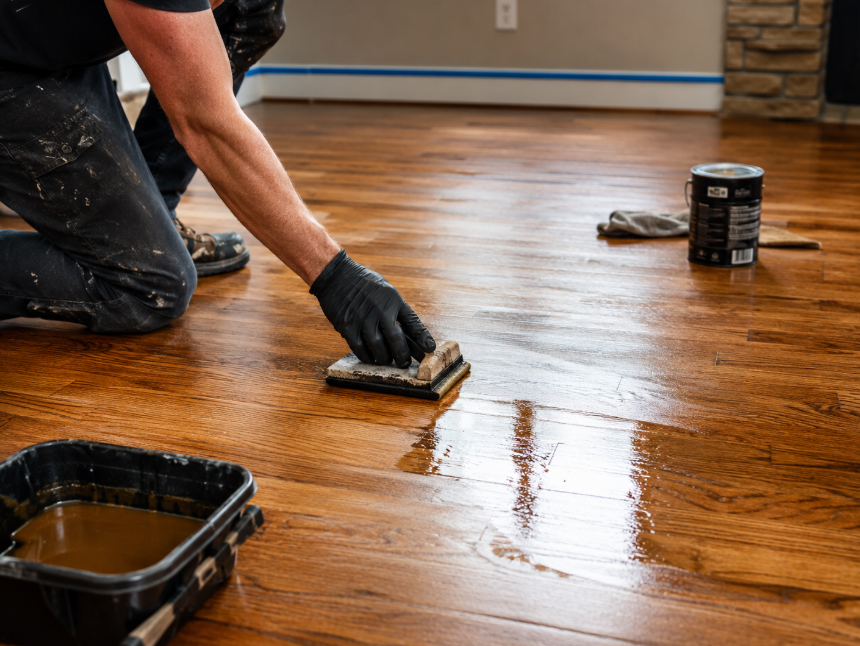
For hardwood refinishing, require professional sanding equipment connected to properly maintained dust-extraction systems. The contractor’s plan should include:
- Dust extraction connected directly to sanding equipment
- Properly fitted HEPA filtration where appropriate
- Sealed doorways and openings around the work zone
- Protection of cabinets, closets, and adjacent rooms
- Isolation of HVAC supply and return vents in the work area
- Frequent removal of collected sanding dust
- HEPA vacuuming after sanding
- Careful cleaning of trim, windowsills, ledges, and horizontal surfaces
No sanding process is literally dust-free. “Dust-controlled” or “HEPA-assisted dust containment” is more accurate. HEPA filtration captures particles; it does not replace ventilation for removing the chemical gases and vapors produced by stains, sealers, or wet finishes.
Prevent dust from entering the HVAC system
A home’s heating and cooling system can spread renovation dust well beyond the immediate work area. Before dusty work begins, ask how supply registers and return-air openings in the renovation zone will be protected — the EPA recommends sealing duct registers in areas where renovation generates substantial dust and debris. The contractor should not cover equipment in a way that creates a mechanical, moisture, combustion, or fire hazard, and HVAC planning should account for the type of system and the weather during the project.
After major dusty work, you may need to inspect accessible registers and grilles, replace the HVAC filter, check adjacent rooms for settled dust, and arrange a professional HVAC evaluation if contamination is suspected. Routine duct cleaning should not automatically be sold as necessary; base that decision on actual conditions.
Exhaust renovation air outdoors
Ventilation should move contaminated air away from occupants and discharge it outdoors — not into another room, hallway, attic, garage, crawlspace, or basement. The EPA identifies outdoor-air ventilation as an important way to reduce indoor pollutant concentrations during remodeling. Ask the contractor to explain:
- Where outdoor exhaust fans will be installed
- How airflow direction will be controlled
- How fresh replacement air will enter
- How long ventilation will operate
- How weather and humidity will be managed
- Whether nearby windows need to stay closed
- Whether fumes could enter neighboring homes
Powerful exhaust fans can create pressure imbalances. In homes with fireplaces, furnaces, boilers, gas water heaters, or other fuel-burning appliances, improper exhaust may contribute to combustion-gas backdrafting. As the Consumer Product Safety Commission warns, backdrafting can pull carbon monoxide into living spaces — so have a qualified HVAC or building professional evaluate unusual ventilation conditions rather than improvising a high-powered exhaust arrangement.
Address moisture and mold before covering surfaces
Water damage should be investigated before new flooring, drywall, cabinets, or finishes are installed. Do not cover damp subfloors, active plumbing leaks, wet drywall, visible mold, persistent musty odors, unexplained staining, or moisture-damaged insulation.
Mold and dampness can aggravate asthma and other respiratory conditions, and the EPA advises correcting moisture problems as part of renovation planning rather than trapping them behind new materials. For hardwood projects, the contractor should test wood and subfloor moisture where conditions warrant it. Installing or coating wood before moisture conditions are acceptable can also lead to cupping, finish failure, and gaps.
Avoid fragrances and odor-masking products
Ask that no fragranced air fresheners, deodorizing sprays, scented cleaners, or odor-masking products be used during or after the renovation. Fragrance is not needed to prove a room is clean, and it can introduce another possible trigger into a home already dealing with dust and coating emissions — the CDC includes certain chemicals and fragrances among possible asthma triggers.
“No added fragrance” does not mean a product will have no odor. Many construction products have an inherent odor during application and curing. The right response to coating fumes is source control, ventilation, and adequate curing — not covering the odor with another chemical.
Plan for the sensitive occupant to leave
For significant asthma or chemical sensitivity, the safest practical plan may be for the affected person to stay elsewhere during high-exposure work. That absence may need to cover:
- Demolition or removal
- Sanding and surface preparation
- Application of adhesives, stains, sealers, paints, or finishes
- Drying between coats
- Initial curing after the final coat
- Ventilation and final cleaning
Remaining in a closed bedroom may not provide adequate separation when the work occurs in the same home. Sensitive occupants should not return simply because workers have left or because a surface feels dry.
Understand drying, curing, and re-entry
Drying and curing are not the same. A coating may feel dry enough to touch or walk on while it is still undergoing chemical and physical changes. The manufacturer may give different timeframes for a second coat, light foot traffic, normal footwear, furniture replacement, pet access, rug placement, routine cleaning, and full cure.
Ask for a written re-entry schedule based on the exact product, number of coats, floor or wall area, temperature, relative humidity, ventilation, building layout, manufacturer instructions, and the occupant’s medical guidance. Do not use odor as the only test — a lack of noticeable odor does not establish that a product has fully cured or that a sensitive person will not react.
Clean before the household returns
Cleaning should remove settled renovation dust without redistributing it into the air. A post-work cleaning plan may include HEPA vacuuming; damp-wiping suitable hard surfaces; cleaning windowsills, trim, doors, ledges, and baseboards; inspecting adjacent rooms; carefully removing protective barriers; bagging and removing debris; replacing the HVAC filter when appropriate; and continuing outdoor ventilation. Avoid ordinary dry sweeping, which can make fine particles airborne again. Agree in advance on who is responsible for final cleaning and what “clean” means.
Questions to ask before signing the contract
Get written answers to the following.
Products
- What exact products will be used?
- Can I review the SDS and technical documents before work begins?
- Are lower-emitting alternatives available?
- Does any product contain added fragrance?
- Will you obtain approval before making a substitution?
Dust
- How will dust be captured at the tool?
- What filtration does the sanding or cutting equipment use?
- How will the work area be isolated?
- How will HVAC vents be protected?
- How will adjacent rooms be inspected and cleaned?
Ventilation
- Where will contaminated air be exhausted?
- How will you prevent airflow into occupied areas?
- How long will ventilation continue?
- Could the exhaust setup affect fuel-burning appliances?
- How will temperature and humidity be controlled?
Scheduling
- Which work stages create the greatest exposure?
- Should the home be vacant during those stages?
- What are the manufacturer’s drying and curing times?
- When may an asthma-sensitive occupant return?
- What conditions could delay re-entry?
Emergencies
- Who should be contacted if unexpected odors, dust migration, water damage, or symptoms occur?
- Will work stop while the problem is evaluated?
- How will a product spill or ventilation failure be handled?
Warning signs when choosing a contractor
Consider another contractor when the company:
- Refuses to identify products in advance
- Will not provide Safety Data Sheets
- Claims the process is completely dust-free
- Guarantees that a product cannot trigger asthma
- Says waterborne means chemical-free
- Plans to use the home’s HVAC system to “clear the fumes”
- Exhausts air into another part of the building
- Treats cure time and dry time as identical
- Uses fragrance to cover construction odors
- Dismisses the homeowner’s medical concerns
- Has no written containment or cleanup procedure
A health-conscious contractor does not need to act as a doctor. The contractor does need to communicate clearly, follow product instructions, control dust, ventilate properly, and respect the household’s health plan.
The bottom line
An asthma-conscious renovation begins before the first wall is opened or the first floorboard is sanded. Focus on five priorities:
- Know exactly which products will be used.
- Control dust and emissions at their source.
- Keep contaminants out of occupied rooms and HVAC systems.
- Vent renovation air directly outdoors.
- Allow sufficient cleaning and curing before re-entry.
The goal is not to find a product labeled “asthma safe” — no single label can account for every person’s triggers or medical condition. The goal is a coordinated plan that combines medical guidance, transparent product selection, professional construction practices, and cautious re-entry.
Medical notice: This article provides general educational information and does not replace personalized medical advice. Homeowners with severe asthma, previous chemical reactions, or other significant respiratory conditions should discuss the planned work and exact products with their healthcare provider. If renovation exposure causes breathing difficulty or other concerning symptoms, leave the affected area and follow the person’s asthma action plan and medical instructions.