
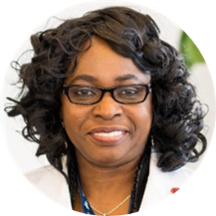
A Johns Hopkins interventional pain physician with a Mass General fellowship who sees patients in Bethesda — one of the few pain specialists in the county who consults in Yoruba as well as English.
View full profile →Care in your language
Yoruba-speaking Doctors in Bethesda & Montgomery County (2026)
Yoruba-speaking physicians serving the Nigerian community across Montgomery and Prince George’s counties. We list 3 Yoruba-speaking providers — 2% of the 139 doctors in our registry — across 3 specialties and 2 areas.
-
-
A board-certified internist in Silver Spring who consults in five languages — English, Yoruba, French, Creole, and Spanish — making him one of the most linguistically accessible primary-care doctors in the county.
View full profile → -
A nationally board-certified family nurse practitioner who founded her own White Oak practice and consults in Igbo, Yoruba, Hausa, Spanish, and English — covering Nigeria's three major languages in one office.
View full profile →

By the numbers
- 3
- Yoruba-speaking doctors in our registry — 2% of all 139
- 5
- further languages spoken by this group — Spanish, Creole, French and 2 more
Figures describe the 139 providers currently in the MyBethesdaDoctor registry as of August 2026 — a curated directory, not a census of every doctor in Montgomery County. How we build this list.
Why language-concordant care matters
"Language-concordant" care — when patient and physician share a language — is consistently linked to better outcomes: patients understand their diagnoses more clearly, follow treatment plans more reliably, ask more questions, and report higher satisfaction. Federal health agencies treat language access as part of quality care, not a courtesy. The U.S. Department of Health and Human Services' Office of Minority Health publishes the National CLAS Standards for culturally and linguistically appropriate services, and the Agency for Healthcare Research and Quality ties limited-English communication to a measurably higher risk of medical error.
The gap shows up most in the conversations that carry the most weight. A medication list read back correctly. A colonoscopy prep followed exactly. A decision about whether an elderly parent should be admitted or cared for at home. Those are the moments where a shared language stops being a preference and starts being clinical.
If no Yoruba-speaking specialist is available: your right to an interpreter
Yoruba-speaking providers are concentrated in primary care, so for a narrower specialty there may be none in the area. You are still entitled to language support. Any healthcare facility that receives federal funding — which includes essentially every hospital and any practice accepting Medicare or Medicaid — must provide meaningful access to patients with limited English proficiency. In practice that means a qualified medical interpreter at no cost to you, usually by phone or video within minutes.
- Request the interpreter when you schedule, not on arrival. It avoids a delayed or rushed appointment.
- Use the professional interpreter rather than a relative. Family members — adult children especially — routinely soften a diagnosis, skip an embarrassing symptom, or answer on the patient's behalf without meaning to. Trained interpreters are bound to convey everything said, in both directions.